Software engineering is the most competitive hiring market in tech. Your resume needs to prove you can design systems, ship reliable code, and operate what you build – not just list languages you've used.
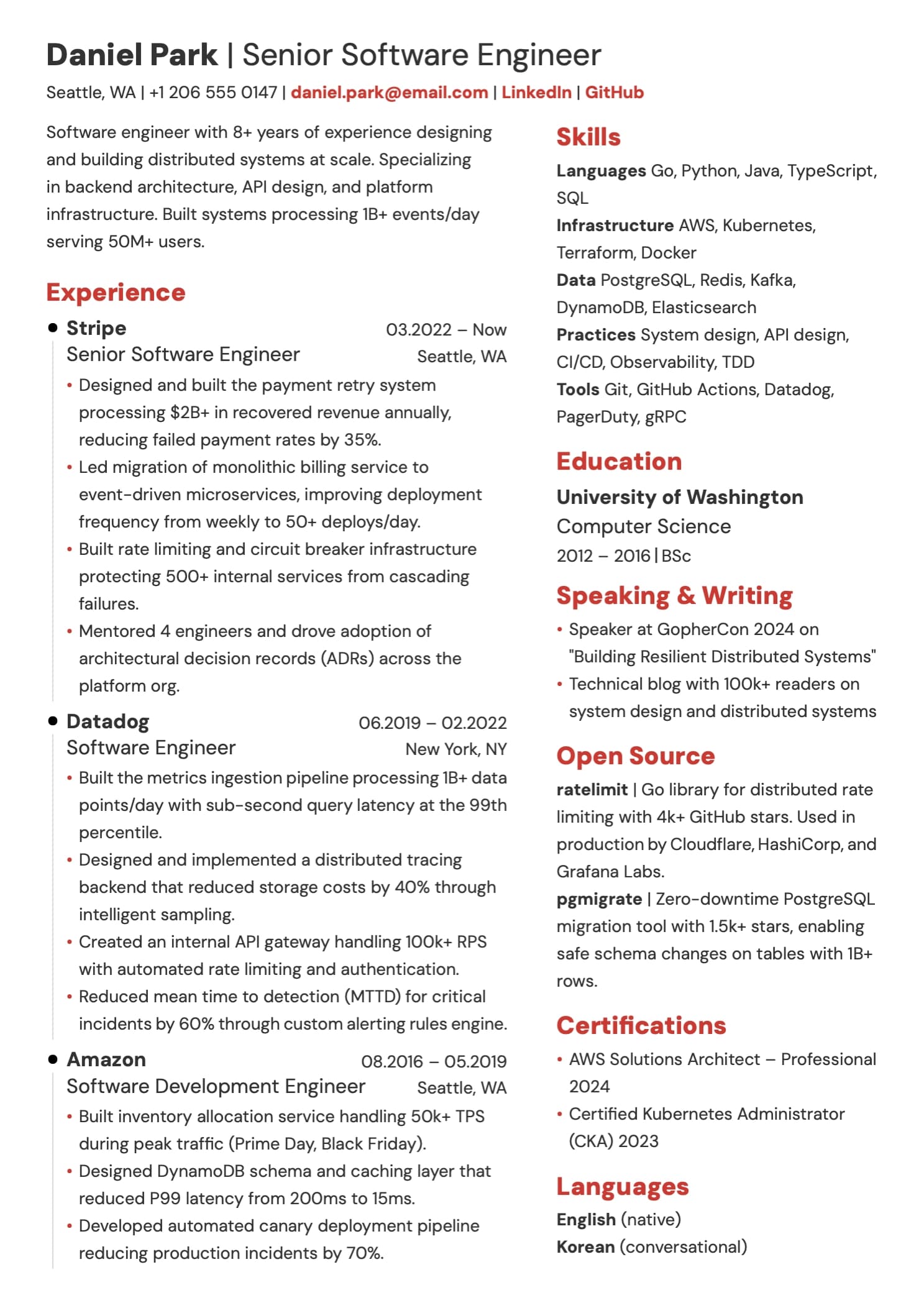
Contact and headline
Lead with your name, title, and GitHub. For software engineers, GitHub is where hiring managers verify that you write real code – not just talk about it.
What works:
- Match the title to the role. If the listing says "Software Engineer," don't write "Full-Stack Developer" or "Backend Developer" unless that's exactly what they're hiring for.
- Include GitHub. Active repositories, meaningful contributions, or well-maintained projects are the strongest signal outside your resume.
- LinkedIn is expected. Keep it updated – many recruiters check it before even reading your resume.
Summary
For software engineers with 3+ years of experience, a summary should signal your depth and the scale you've operated at.
Example:
Software engineer with 8+ years of experience designing and building distributed systems at scale. Specializing in backend architecture, API design, and platform infrastructure. Built systems processing 1B+ events/day serving 50M+ users.
What to avoid:
- Vague claims like "passionate engineer who loves solving problems." Every engineer says that. Be specific about what systems, at what scale, and for whom.
- Listing languages without context. "Go, Python, Java" says nothing – save the stack for the skills section.
Skills
Group skills by function, not by proficiency level. Nobody cares about your self-assessed "advanced" vs. "intermediate" ratings. Hiring managers scan this section in seconds looking for their stack.
Example layout:
- Languages: Go, Python, Java, TypeScript, SQL
- Infrastructure: AWS, Kubernetes, Terraform, Docker
- Data: PostgreSQL, Redis, Kafka, DynamoDB, Elasticsearch
- Practices: System design, API design, CI/CD, Observability, TDD
- Tools: Git, GitHub Actions, Datadog, PagerDuty, gRPC
Tips:
- Mirror the job description. If they mention "Kubernetes," don't write "container orchestration."
- Include a "Practices" category. Companies want engineers who understand how to build software, not just what tools to use. System design, observability, and CI/CD signal senior thinking.
- Don't list every language you've ever touched. Five to six core technologies per category is plenty. Padding with "HTML, CSS" on a backend-heavy resume looks unfocused.
Experience
This is where you prove you build things that matter. For each role, follow the pattern: what you designed → at what scale → with what result.
Strong bullets:
- Designed and built the payment retry system processing $2B+ in recovered revenue annually, reducing failed payment rates by 35%.
- Led migration of monolithic billing service to event-driven microservices, improving deployment frequency from weekly to 50+ deploys/day.
- Built the metrics ingestion pipeline processing 1B+ data points/day with sub-second query latency at the 99th percentile.
- Designed DynamoDB schema and caching layer that reduced P99 latency from 200ms to 15ms.
Weak bullets:
- Worked on backend services for the platform team.
- Responsible for designing and implementing APIs.
- Used Go and Kubernetes for various projects.
The difference: specific systems, concrete scale, and measurable outcomes. "Worked on backend services" is instantly forgettable. "Built metrics ingestion pipeline processing 1B+ data points/day with sub-second P99 latency" tells a hiring manager exactly what you're capable of.
System design as a differentiator
System design skills are the clearest signal of seniority on a software engineer resume. If you've designed distributed systems, made architectural decisions, or led migrations – quantify them:
- Instead of "Improved the architecture," write "Led migration of monolithic billing service to event-driven microservices, improving deployment frequency from weekly to 50+ deploys/day."
- Latency percentiles (P99, P95), throughput (TPS, RPS), and availability metrics (uptime, incident reduction) are concrete numbers that hiring managers understand immediately.
Reliability and operational ownership
One of the strongest signals on a senior SE resume is showing that you own what you build in production:
- Instead of "Wrote monitoring dashboards," write "Built rate limiting and circuit breaker infrastructure protecting 500+ internal services from cascading failures."
- Reducing incidents, improving MTTR, and building deployment safety nets (canary deploys, feature flags) show you think beyond just writing code.
Education
For software engineering, education matters less than what you've shipped. A CS degree is a strong foundation, but many excellent engineers come from bootcamps, self-study, or adjacent fields.
Example:
BSc Computer Science, University of Washington, 2016
If your degree is in a different field, don't hide it – highlight how it gives you a unique perspective. Physics graduates bring mathematical rigor, linguistics graduates think differently about parsing and data structures.
Open source
Open-source contributions prove you can write code that others trust enough to use in production. For software engineers, this is one of the most powerful resume sections.
Example:
ratelimit | Go library for distributed rate limiting with 4k+ GitHub stars. Used in production by Cloudflare, HashiCorp, and Grafana Labs.
Include star counts and adoption metrics. A library "used in production by Cloudflare" says more than any description of what it does.
Speaking and writing
Technical talks and writing demonstrate depth of understanding and the ability to communicate complex ideas – both critical for senior roles.
Example:
- Speaker at GopherCon 2024 on "Building Resilient Distributed Systems"
- Technical blog with 100k+ readers on system design and distributed systems
Tips:
- Conference talks at recognized events (GopherCon, KubeCon, Strange Loop) carry real weight.
- A technical blog with meaningful readership signals genuine expertise. "100k+ readers" is more compelling than "I write about tech."
- Internal tech talks count too, especially if you can mention the audience size or organizational impact.
Formatting and length
- One page is ideal for most software engineers. Two pages only if you have 10+ years and every line genuinely earns its space.
- Both single and two-column layouts work. Two columns help when you have several short sections (skills, certs, languages, open source) alongside experience. Single column works when your experience section does the heavy lifting. For a deeper comparison, see our one-column vs. two-column resume guide.
- PDF format. Always.
Common mistakes
- Listing languages without context. "Go" means nothing alone. Show what you built with it, what scale it handled, and what improved as a result.
- Ignoring operational impact. Software engineering doesn't end at merging the PR. If you've reduced incidents, improved deployment speed, or built observability – say so. These are senior signals.
- No GitHub link. For software engineering roles, this is almost as important as the resume itself. Make sure your pinned repos represent your best work.
- Confusing activity with impact. "Wrote 200+ PRs" is activity. "Led migration of monolithic service to microservices, improving deployment frequency from weekly to 50+ deploys/day" is impact. Not sure how to quantify your work? Check our guide on how to quantify achievements on any resume.
- Overloading with buzzwords. "Leveraged cloud-native microservices architecture utilizing event-driven paradigms" reads like a parody. Say what you built, how big it was, and what happened.
Software engineer vs. related roles
These are different roles with different expectations. Your resume should reflect the one you're targeting:
- Software Engineer: System design, backend architecture, distributed systems, API design, operational ownership, production reliability.
- Frontend Engineer: UI frameworks, performance optimization, design systems, accessibility, browser APIs. If this is your focus, check our frontend engineer resume example.
- DevOps/SRE: Infrastructure automation, CI/CD pipelines, incident response, monitoring, capacity planning.
- ML Engineer: Model deployment, training pipelines, feature engineering, MLOps.
Don't try to look like an ML engineer on a software engineering resume. Lean into your strengths: building reliable systems, designing clean APIs, and shipping code that works at scale.
Tailoring for specific roles
Software engineering job titles vary. A "Backend Engineer" role emphasizes APIs, databases, and distributed systems. A "Platform Engineer" role focuses on developer tools, CI/CD, and internal infrastructure. A "Staff Engineer" role expects architectural leadership and cross-team influence.
Read the job description carefully and adjust emphasis accordingly. Use a tool like HiredByThis to maintain a master CV and quickly generate tailored versions – with AI doing the heavy lifting while you stay in control.