Data science roles attract hundreds of applicants. Your resume needs to demonstrate both technical depth and business impact – showing that you can build models and ship results.
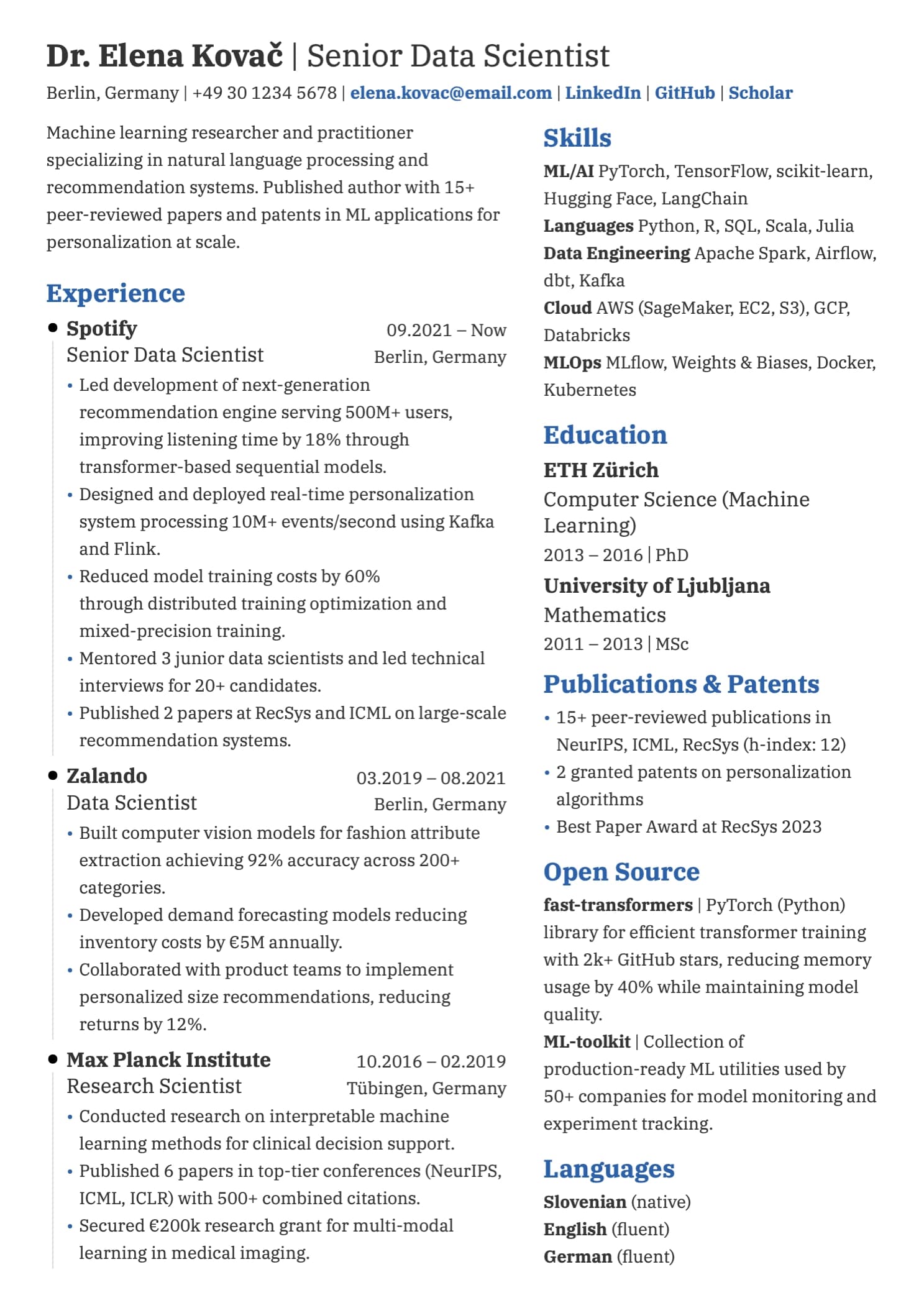
Contact and headline
Lead with your name, title, and relevant links. Data science is one of the few fields where GitHub, Google Scholar, or a personal blog genuinely matter.
What works:
- Match the title to the role. If the listing says "ML Engineer," don't write "Data Analyst" or "Statistician."
- Include GitHub and Scholar. If you have meaningful open-source contributions or publications, link them. Recruiters check.
- Skip the physical address. City is enough.
Summary
For data scientists with 3+ years of experience, a summary is valuable. State your specialization, years of experience, and one or two measurable outcomes.
Example:
Machine learning researcher and practitioner specializing in NLP and recommendation systems. Published author with 15+ peer-reviewed papers and patents in ML applications for personalization at scale.
What to avoid:
- Buzzword soup like "passionate AI enthusiast leveraging cutting-edge deep learning." Be specific about what you've done.
- Listing every technique you've heard of. Save that for the skills section.
Skills
Group technical skills logically. Data science hiring managers scan this section quickly – make it easy to parse.
Example layout:
- ML/AI: PyTorch, TensorFlow, scikit-learn, Hugging Face, LangChain
- Languages: Python, R, SQL, Scala, Julia
- Data Engineering: Apache Spark, Airflow, dbt, Kafka
- Cloud: AWS (SageMaker, EC2, S3), GCP, Databricks
- MLOps: MLflow, Weights & Biases, Docker, Kubernetes
Tips:
- Mirror the job description. If they mention "PyTorch," don't write "deep learning frameworks."
- Separate ML-specific skills from general engineering skills. It shows you understand the domain.
- Include MLOps tools. Companies care about deploying models, not just training them in notebooks.
Experience
This is where you prove impact. For each role, follow the pattern: what you built → at what scale → with what result.
Strong bullets:
- Led development of a recommendation engine serving 500M+ users, improving listening time by 18% through transformer-based sequential models.
- Designed a real-time personalization system processing 10M+ events/second using Kafka and Flink.
- Built computer vision models for attribute extraction achieving 92% accuracy across 200+ categories.
- Developed demand forecasting models reducing inventory costs by $5M annually.
Weak bullets:
- Worked on machine learning models for the team.
- Responsible for data analysis and reporting.
- Used Python and SQL for various projects.
The difference: specific models, concrete scale, and measurable business outcomes. Hiring managers want to see that your models shipped and made a difference.
Research vs. industry experience
If you're transitioning from academia, translate your research into business language:
- Instead of "Published 6 papers at NeurIPS," write "Published 6 papers at NeurIPS (500+ combined citations), focusing on interpretable ML methods later adopted in production clinical decision support systems."
- Quantify grant funding you secured – it shows you can make a business case.
Education
For data science, education carries more weight than in general software engineering – especially if you have a PhD or a quantitative master's degree.
Example:
PhD Computer Science (Machine Learning), ETH Zurich, 2016 MSc Mathematics, University of Ljubljana, 2013
If your degree is in a different field (physics, economics, biology), highlight relevant coursework or thesis work that demonstrates quantitative skills.
Publications and patents
This section is unique to research-heavy roles. Include it if you have peer-reviewed publications, patents, or notable open-source contributions.
Example:
- 15+ peer-reviewed publications in NeurIPS, ICML, RecSys (h-index: 12)
- 2 granted patents on personalization algorithms
- Best Paper Award at RecSys 2023
Tips:
- Lead with the numbers (publication count, h-index, citation count).
- Mention specific top-tier venues by name – they carry weight.
- If you have patents, include them. They signal real-world applicability of your research.
Open source and projects
Open-source contributions demonstrate that you can write production-quality code, not just experiment in notebooks.
Example:
fast-transformers | PyTorch library for efficient transformer training with 2k+ GitHub stars. Reduces memory usage by 40% while maintaining model quality.
Include star counts and adoption metrics. A project used by "50+ companies" says more than a description of what it does.
Formatting and length
- Two pages are acceptable for senior data scientists with publications and research experience. One page for those with less than 5 years.
- Both single and two-column layouts work. Two columns help if you have many short sections (skills, publications, certifications) competing for space. Single column is cleaner when your experience and research sections do the heavy lifting. Choose based on how much content you need to fit, not the role. For a deeper comparison, see our one-column vs. two-column resume guide.
- PDF format. Always.
Common mistakes
- Listing tools without context. "PyTorch" means nothing alone. Show what you built with it and at what scale.
- Ignoring business impact. "Trained a model with 95% accuracy" is incomplete. What did that accuracy do for the business? Not sure how to quantify your work? Check our guide on how to quantify achievements on any resume.
- Overloading with academic jargon. If you're applying to an industry role, translate "novel attention mechanism for multi-modal feature fusion" into "ML system that combined text and image data, improving product recommendations by 15%."
- Omitting MLOps experience. Companies want to know you can deploy and monitor models, not just train them.
Tailoring for specific roles
Data science job titles vary wildly. An "ML Engineer" role emphasizes deployment and systems. A "Research Scientist" role emphasizes publications and novel methods. A "Data Scientist" role often means end-to-end ownership from analysis to production.
Read the job description carefully and adjust emphasis accordingly. Use a tool like HiredByThis to maintain a master CV and quickly generate tailored versions – with AI doing the heavy lifting while you stay in control.