Data analyst roles sit at the intersection of business and data. Your resume needs to show that you can pull insights from messy datasets and communicate them clearly to stakeholders who don't speak SQL.
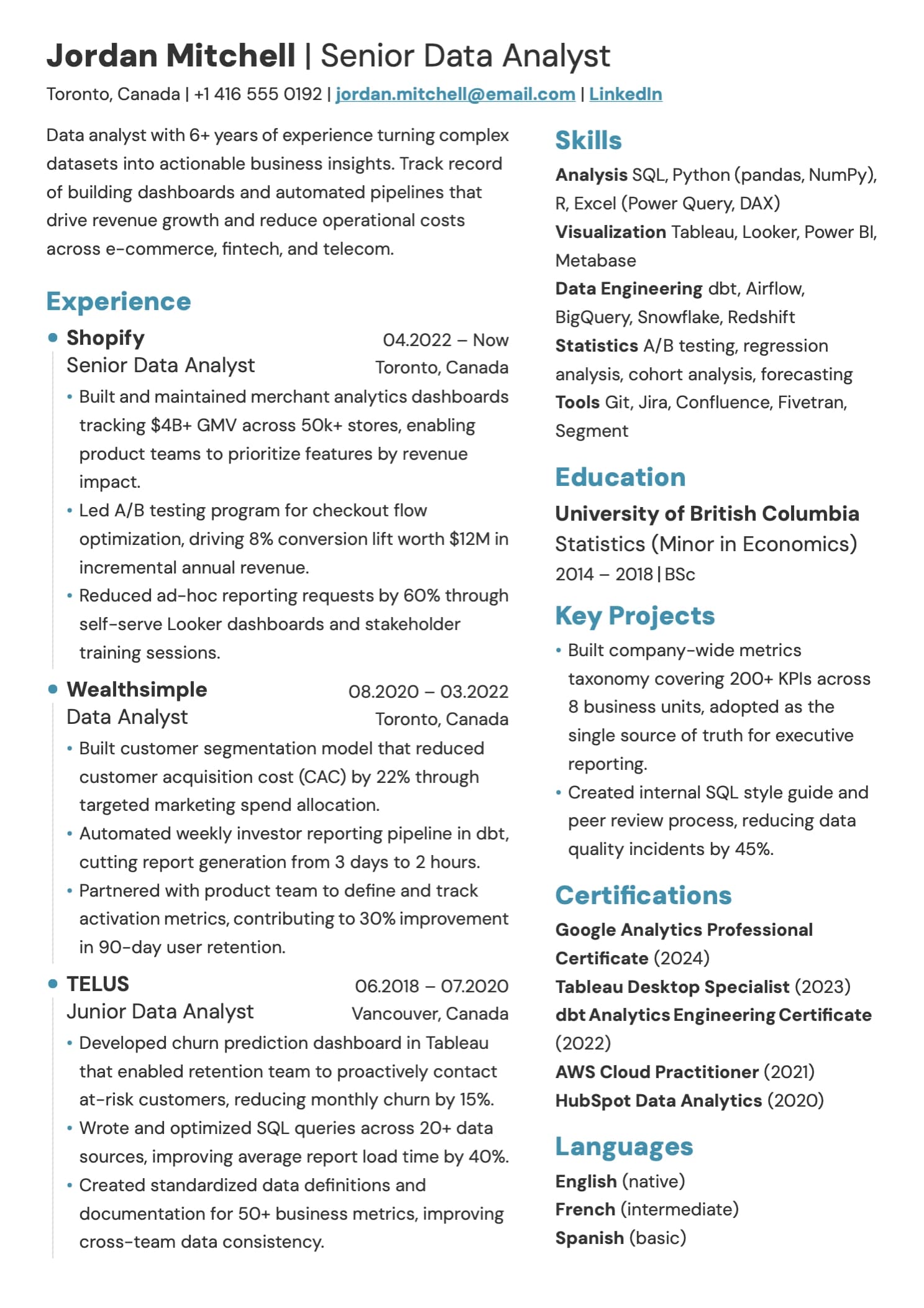
Contact and headline
Lead with your name, title, and LinkedIn. Unlike data scientists, data analysts rarely need GitHub or Scholar links – your impact lives in dashboards and business decisions, not repositories.
What works:
- Match the title to the role. If the listing says "Business Intelligence Analyst," don't write "Data Scientist" or "Reporting Analyst."
- Include LinkedIn. It's where hiring managers check your recommendations and career trajectory.
- Skip the physical address. City is enough.
Summary
For data analysts with 3+ years of experience, a summary should signal your domain expertise and the scale of data you've worked with.
Example:
Data analyst with 6+ years of experience turning complex datasets into actionable business insights. Track record of building dashboards and automated pipelines that drive revenue growth and reduce operational costs across e-commerce, fintech, and telecom.
What to avoid:
- Vague claims like "detail-oriented analyst passionate about data." Be specific about what data, at what scale, and for whom.
- Listing tools without context. "SQL and Tableau" says nothing – save the stack for the skills section.
Skills
Group skills by function. Data analyst hiring managers scan this in seconds looking for SQL, their BI tool, and statistical methods.
Example layout:
- Analysis: SQL, Python (pandas, NumPy), R, Excel (Power Query, DAX)
- Visualization: Tableau, Looker, Power BI, Metabase
- Data Engineering: dbt, Airflow, BigQuery, Snowflake, Redshift
- Statistics: A/B testing, regression analysis, cohort analysis, forecasting
- Tools: Git, Jira, Confluence, Fivetran, Segment
Tips:
- SQL first. It's the core skill. If the job description mentions "advanced SQL," make sure your experience section backs that up with specific examples.
- Include the exact BI tools they use. "Tableau" and "Looker" are not interchangeable in a recruiter's keyword scan.
- Data engineering skills like dbt and Airflow set you apart from analysts who only consume data.
Experience
This is where you prove business impact. For each role, follow the pattern: what you analyzed → what you built → what changed as a result.
Strong bullets:
- Built merchant analytics dashboards tracking $4B+ GMV across 50k+ stores, enabling product teams to prioritize features by revenue impact.
- Designed automated anomaly detection pipeline that identified pricing errors saving $2M annually.
- Led A/B testing program for checkout optimization, driving 8% conversion lift worth $12M in incremental annual revenue.
- Built customer segmentation model that reduced CAC by 22% through targeted marketing spend allocation.
Weak bullets:
- Created dashboards for the business team.
- Responsible for data analysis and reporting.
- Used SQL and Python for various analytical projects.
The difference: specific business outcomes, concrete scale, and dollar impact. "Created dashboards" is forgettable. "Built dashboards tracking $4B+ GMV that enabled product teams to prioritize by revenue impact" tells a hiring manager exactly what you can do.
Automation and self-serve analytics
One of the strongest signals on a data analyst resume is showing that you reduced the need for ad-hoc work:
- Instead of "Answered stakeholder data requests," write "Reduced ad-hoc reporting requests by 60% through self-serve Looker dashboards and stakeholder training sessions."
- Automating a 3-day manual process into a 2-hour pipeline is more impressive than any single analysis. Quantify the time saved.
Education
For data analysts, a quantitative degree helps but isn't mandatory. Statistics, economics, math, or computer science are all strong foundations.
Example:
BSc Statistics, University of British Columbia, 2018
If your degree is in a different field, highlight relevant coursework in statistics, econometrics, or data analysis. Many strong analysts come from business, social science, or engineering backgrounds.
Certifications
Certifications carry more weight for data analysts than for data scientists. They signal structured knowledge of industry-standard tools.
Example:
- Google Analytics Professional Certificate (2024)
- Tableau Desktop Specialist (2023)
- dbt Analytics Engineering Certificate (2022)
Tips:
- Prioritize vendor certifications for tools listed in the job description.
- Recent certifications (within 2 years) show you stay current.
- Don't pad with introductory courses. "Google Data Analytics Certificate" is fine for entry-level roles but looks thin on a senior resume.
Formatting and length
- One page is ideal for most data analysts. Two pages only if you have 8+ years of genuinely impactful experience.
- Both single and two-column layouts work. Two columns help when you have several short sections (skills, certifications, languages) alongside experience. Single column works when your experience bullets do the heavy lifting. For a deeper comparison, see our one-column vs. two-column resume guide.
- PDF format. Always.
Common mistakes
- No business context. "Wrote SQL queries" means nothing. What decisions did those queries inform? What revenue did they protect? Not sure how to quantify your work? Check our guide on how to quantify achievements on any resume.
- Confusing data analyst with data scientist. If you're applying for an analyst role, lead with SQL, dashboards, and business impact – not PyTorch, neural networks, or research publications.
- Listing tools without scale. "Used Tableau" is empty. "Built Tableau dashboards tracking $4B+ GMV across 50k+ stores" earns its space.
- Ignoring the stakeholder side. Data analysts don't just query databases – they communicate findings. Mention presentations to leadership, training sessions, or self-serve tools you built for non-technical teams.
Data analyst vs. data scientist
These are different roles. If you're applying as a data analyst, your resume should reflect that:
- Data analyst: SQL-first, dashboards, business metrics, stakeholder communication, A/B testing, certifications.
- Data scientist: Python/R-first, ML models, research publications, PhD, open-source contributions.
Don't try to look like a data scientist on a data analyst resume. The hiring manager knows the difference. Lean into your strengths: speed of insight, business fluency, and the ability to make data accessible to everyone in the organization. If you are targeting data scientist roles, check out our data scientist resume example.
Tailoring for specific roles
Data analyst titles vary. A "Business Intelligence Analyst" emphasizes dashboards and reporting infrastructure. A "Product Analyst" focuses on feature metrics and experimentation. A "Marketing Analyst" cares about attribution, funnel analysis, and campaign ROI. A "Financial Analyst" expects modeling and forecasting skills.
Read the job description carefully and adjust emphasis accordingly. Use a tool like HiredByThis to maintain a master CV and quickly generate tailored versions – with AI doing the heavy lifting while you stay in control.