Frontend engineering roles are competitive. Your resume needs to show that you can build fast, accessible interfaces and ship them reliably – not just that you know React.
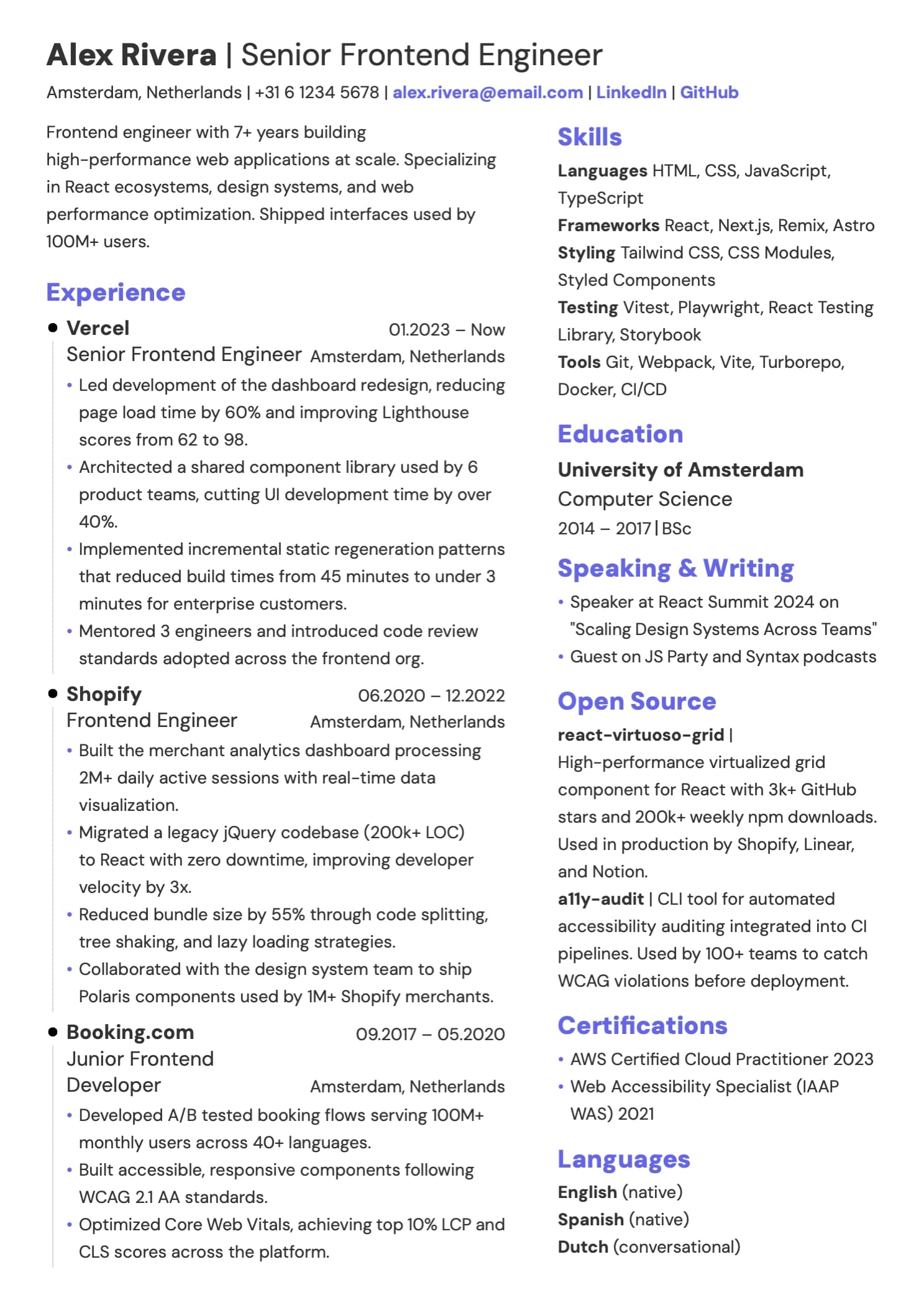
Contact and headline
Lead with your name, title, and links that matter. For frontend engineers, GitHub is almost mandatory – it's where hiring managers verify your code quality.
What works:
- Match the title to the role. If the listing says "Frontend Engineer," don't write "Full-Stack Developer" or "Web Developer".
- Include GitHub. Active repositories, open-source contributions, or a well-organized profile are a very important addition to your CV.
- Add a portfolio if you have one. A personal site built with modern tools is a resume artifact in itself.
Summary
For frontend engineers with 3+ years of experience, a summary is worth the space. State your specialization, years of experience, and one or two measurable outcomes.
Example:
Frontend engineer with 7+ years building high-performance web applications at scale. Specializing in React ecosystems, design systems, and web performance optimization. Shipped interfaces used by 100M+ users.
What to avoid:
- Buzzwords like "passionate developer who loves crafting pixel-perfect UIs." Be specific about what you've built and at what scale.
- Listing every framework you've touched. Save that for the skills section.
Skills
Group technical skills by category. Frontend hiring managers scan this section in seconds – make it easy to parse.
Example layout:
- Languages: HTML, CSS, JavaScript, TypeScript
- Frameworks: React, Next.js, Remix, Astro
- Styling: Tailwind CSS, CSS Modules, Styled Components
- Testing: Vitest, Playwright, React Testing Library, Storybook
- Tools: Git, Webpack, Vite, Turborepo, Docker, CI/CD
Tips:
- Mirror the job description. If they mention "Next.js," don't just write "React frameworks."
- Separate frontend-specific skills from general tools. It shows domain awareness.
- Include testing tools. Companies want engineers who write tests, not just features.
Experience
This is where you prove impact. For each role, follow the pattern: what you built → at what scale → with what result.
Strong bullets:
- Led development of the dashboard redesign, reducing page load time by 60% and improving Lighthouse scores from 62 to 98.
- Migrated a legacy jQuery codebase (200k+ LOC) to React with zero downtime, improving developer velocity by 3x.
- Reduced bundle size by 55% through code splitting, tree shaking, and lazy loading strategies.
- Architected a shared component library used by 6 product teams, cutting UI development time by 40%.
Weak bullets:
- Worked on the frontend of the application.
- Responsible for building React components.
- Used TypeScript and CSS for various projects.
The difference: specific technologies, concrete scale, and measurable business outcomes. "Built React components" is forgettable. "Migrated 200k+ LOC to React with zero downtime, improving developer velocity 3x" sticks.
Performance as a differentiator
Web performance is one of the strongest signals on a frontend resume. If you've improved Core Web Vitals, reduced bundle sizes, or optimized rendering – quantify it:
- Instead of "Improved page performance," write "Optimized Core Web Vitals, achieving top 10% LCP and CLS scores across the platform."
- Lighthouse scores, load times, and bundle size reductions are concrete metrics that hiring managers understand immediately.
Education
For frontend engineering, education matters less than what you've shipped. A CS degree is great, but many strong frontend engineers come from bootcamps, self-study, or adjacent fields.
Example:
BSc Computer Science, University of Amsterdam, 2017
If your degree is in a non-technical field, highlight how it gives you a unique perspective – design thinking, linguistics for i18n, or psychology for UX.
Speaking and writing
Conference talks and technical writing demonstrate thought leadership and deep understanding – both valued in senior roles.
Example:
- Speaker at React Summit 2024 on "Scaling Design Systems Across Teams"
- Guest on JS Party and Syntax podcasts
Tips:
- Mention the event name and topic – specifics build credibility.
- Blog posts with readership metrics count. "Technical articles with 50k+ readers" signals genuine influence.
- Local meetup talks are valid too, especially if you're earlier in your career.
Open source
Open-source contributions are the closest thing to a portfolio for frontend engineers. They prove you can write clean, documented, production-quality code.
Example:
react-virtuoso-grid | High-performance virtualized grid component for React with 3k+ GitHub stars and 200k+ weekly npm downloads. Used in production by Shopify, Linear, and Notion.
Include star counts and adoption metrics. A library used by known companies says more than a description of what it does.
Formatting and length
- One page is ideal for most frontend engineers. Two pages only if you have 10+ years and every line genuinely earns its space.
- Both single and two-column layouts work. Two columns help if you have many short sections (skills, certs, languages, open source) competing for space. Single column is simpler and works better when your experience section is the main focus. Pick whichever keeps your content readable without awkward gaps. For a deeper comparison, see our one-column vs. two-column resume guide.
- PDF format. Always.
Common mistakes
- Listing frameworks without context. "React" means nothing alone. Show what you built with it, how many users it served, and what improved.
- Ignoring performance. Frontend is one of the few roles where you can quantify your work in milliseconds. Use that advantage.
- No GitHub link. For frontend roles, this is almost as important as the resume itself. Make sure your profile is clean and your pinned repos represent your best work.
- Overemphasizing tools over outcomes. Hiring managers care about what you delivered, not your webpack config. Not sure how to quantify your work? Check our guide on how to quantify achievements on any resume.
Tailoring for specific roles
Frontend job titles vary. A "Frontend Engineer" role usually means building UI with a framework. A "UI Engineer" role may focus on design systems and component APIs. A "Full-Stack" role expects backend comfort too.
Read the job description carefully and adjust emphasis accordingly. Use a tool like HiredByThis to maintain a master CV and quickly generate tailored versions – with AI doing the heavy lifting while you stay in control.