Marketing manager roles get flooded with applicants. Your resume needs to prove you can drive measurable business outcomes – not just "run campaigns." Numbers, channels, and revenue impact separate the strong candidates from the rest.
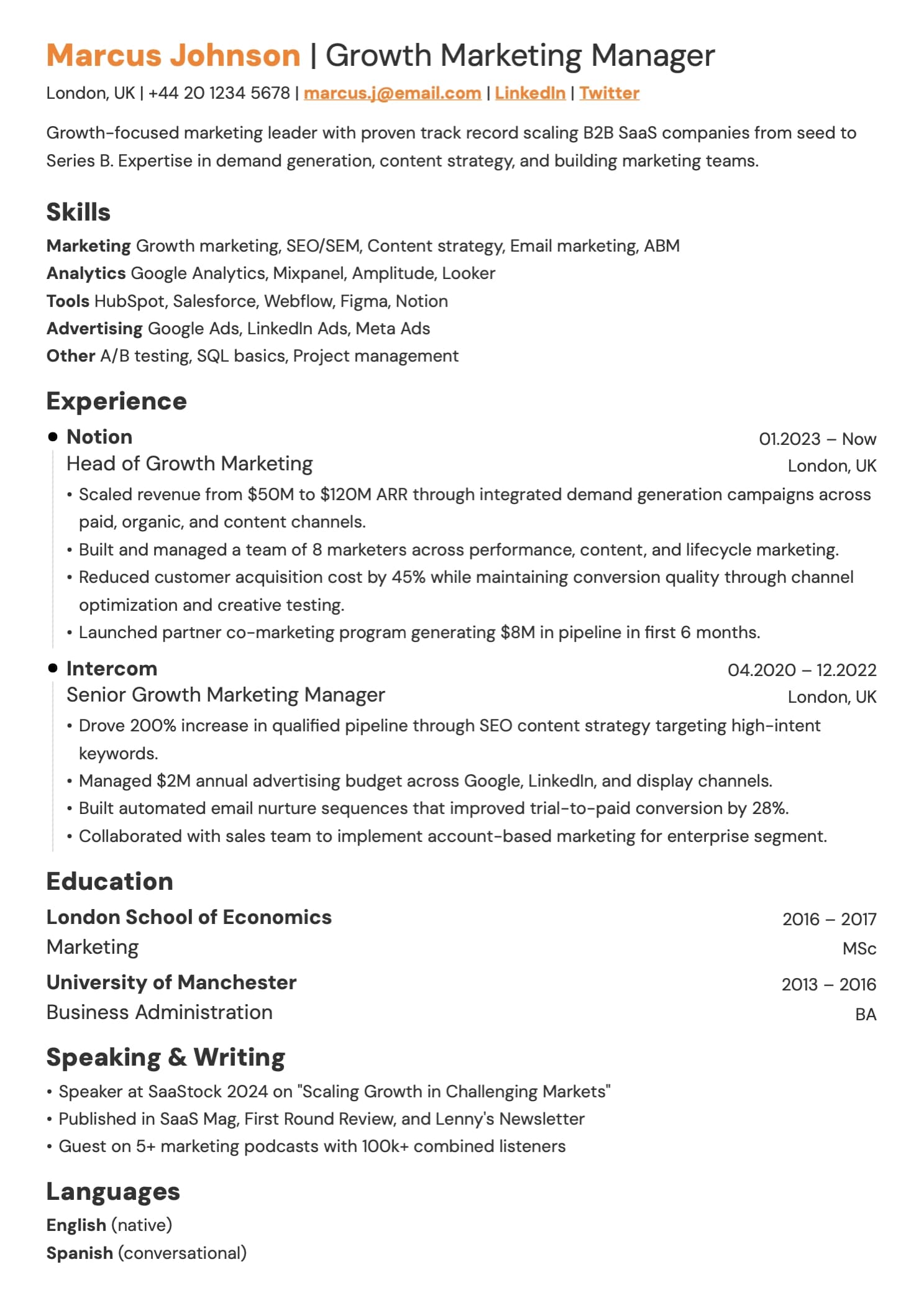
Contact and headline
Lead with your name, title, and professional links. Marketing is a relationship-driven field – LinkedIn matters more here than in most roles.
What works:
- Match the title to the role. If the listing says "Growth Marketing Manager," don't write "Digital Marketer" or "Brand Specialist."
- Include LinkedIn and Twitter/X. If you have a professional presence with industry content, link it. Hiring managers check.
- Skip the physical address. City is enough. Remote-friendly roles don't need it at all.
Summary
For marketers with 3+ years of experience, a summary should immediately signal your niche and scale. State your specialization, the type of companies you've worked with, and one or two headline metrics.
Example:
Growth-focused marketing leader with proven track record scaling B2B SaaS companies from seed to Series B. Expertise in demand generation, content strategy, and building marketing teams.
What to avoid:
- Vague claims like "results-driven marketing professional with a passion for brand storytelling." Be specific about what results and which brands.
- Listing every marketing buzzword. Save channels and tools for the skills section.
Skills
Group skills by function. Marketing hiring managers scan this section to confirm you cover the channels and tools they need.
Example layout:
- Marketing: Growth marketing, SEO/SEM, Content strategy, Email marketing, ABM
- Analytics: Google Analytics, Mixpanel, Amplitude, Looker
- Tools: HubSpot, Salesforce, Webflow, Figma, Notion
- Advertising: Google Ads, LinkedIn Ads, Meta Ads
- Other: A/B testing, SQL basics, Project management
Tips:
- Mirror the job description. If they mention "HubSpot," don't write "CRM platforms."
- Include analytics tools. Companies want marketers who measure everything, not just launch and hope.
- List any technical skills like SQL or basic data analysis – they set you apart from the pack.
Experience
This is where you prove ROI. For each role, follow the pattern: what you drove → through what channels → with what result.
Strong bullets:
- Scaled revenue from $50M to $120M ARR through integrated demand generation campaigns across paid, organic, and content channels.
- Reduced customer acquisition cost by 45% while maintaining conversion quality through channel optimization and creative testing.
- Drove 200% increase in qualified pipeline through SEO content strategy targeting high-intent keywords.
- Built automated email nurture sequences that improved trial-to-paid conversion by 28%.
Weak bullets:
- Managed social media accounts and created content.
- Responsible for the marketing budget.
- Worked with the sales team on lead generation.
The difference: specific revenue numbers, percentage improvements, and clear cause-and-effect. "Managed $2M annual advertising budget" is factual but flat. "Managed $2M annual advertising budget across Google and LinkedIn, reducing CAC by 45% while scaling qualified pipeline by 200%" tells a story.
Building and managing teams
If you've built or managed a team, highlight it – it signals you're ready for leadership roles:
- Instead of "Led a marketing team," write "Built and managed a team of 8 marketers across performance, content, and lifecycle marketing, growing the function from 2 to 8 in 18 months."
- Mention cross-functional collaboration with sales. Marketing-sales alignment is a major pain point at most companies – showing you've solved it is valuable.
Education
For marketing, education carries moderate weight. An MBA or a specialized marketing degree from a strong program is a plus, but practical results matter more.
Example:
MSc Marketing, London School of Economics, 2017 BA Business Administration, University of Manchester, 2016
If your degree is in an unrelated field, don't worry – marketing is one of the most accessible fields for career switchers. Highlight relevant certifications or courses instead.
Speaking and writing
Thought leadership signals expertise and industry recognition. If you speak at conferences, write for publications, or guest on podcasts – include it.
Example:
- Speaker at SaaStock 2024 on "Scaling Growth in Challenging Markets"
- Published in SaaS Mag, First Round Review, and Lenny's Newsletter
- Guest on 5+ marketing podcasts with 100k+ combined listeners
Tips:
- Name the publications and conferences – specifics build credibility.
- Include audience or listener numbers where possible.
- If you run your own newsletter or blog with meaningful subscriber counts, mention it.
Formatting and length
- One page is ideal for most marketing managers. Two pages only if you're a VP-level leader with 15+ years of relevant experience.
- Both single and two-column layouts work. Single column reads well when your content is mostly narrative bullet points. Two columns can help if you have several short sections (tools, certifications, languages) alongside your experience. Choose based on your content, not your job title. For a deeper comparison, see our one-column vs. two-column resume guide.
- PDF format. Always.
Common mistakes
- No numbers. Marketing is one of the most measurable functions. If your resume doesn't include revenue, pipeline, conversion rates, or CAC figures, it looks like you either didn't track results or didn't have good ones. Not sure how to quantify your work? Check our guide on how to quantify achievements on any resume.
- Listing channels without outcomes. "Managed Google Ads" means nothing alone. Show the budget, the results, and the efficiency gains.
- Confusing activity with impact. "Wrote 50 blog posts" is activity. "Built SEO content engine that drove 200% increase in qualified pipeline" is impact.
- Ignoring the funnel. Show that you understand the full journey from awareness to revenue, not just one slice.
Tailoring for specific roles
Marketing job titles vary wildly. A "Growth Marketing Manager" focuses on acquisition and pipeline. A "Content Marketing Manager" emphasizes editorial strategy and SEO. A "Product Marketing Manager" bridges product and go-to-market. A "Brand Manager" cares about positioning and perception.
Read the job description carefully and adjust emphasis accordingly. Use a tool like HiredByThis to maintain a master CV and quickly generate tailored versions – with AI doing the heavy lifting while you stay in control.