Design hiring is portfolio-first – but your resume still determines whether anyone opens that portfolio link. A strong product designer resume shows process, impact, and collaboration, not just pretty pixels.
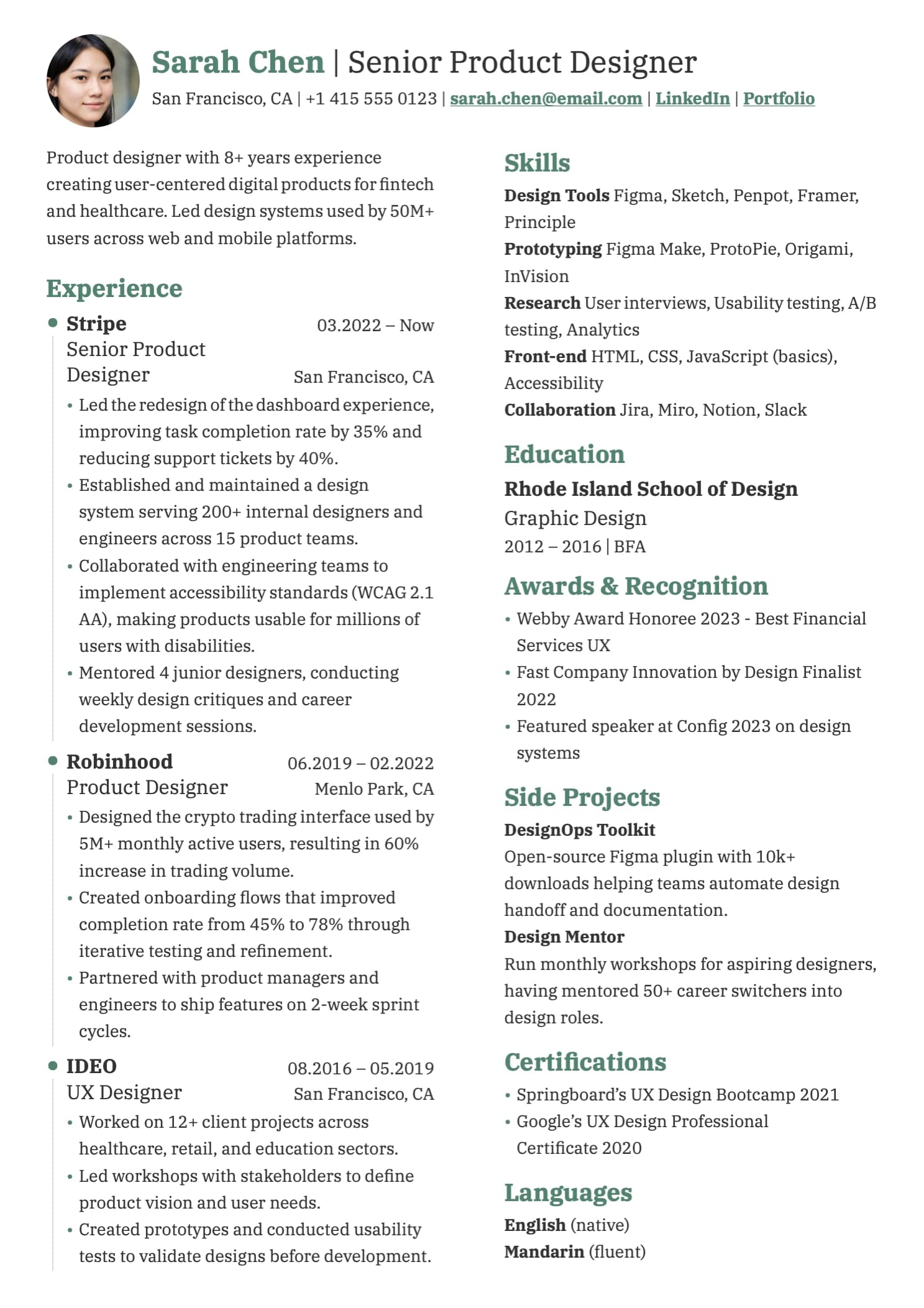
Contact and headline
Lead with your name, title, and a portfolio link. The portfolio link is the single most important element on a product designer's resume – make it impossible to miss.
What works:
- Match the title to the role. If the listing says "Product Designer," don't write "Visual Designer" or "UX/UI Designer" unless that's what they're looking for.
- Link your portfolio prominently. Place it right in the contact line, not buried at the bottom.
- Include LinkedIn. Design managers check it for recommendations and endorsements from cross-functional partners.
Summary
For designers with 3+ years of experience, a summary sets the stage. State your specialization, years of experience, and one or two impact metrics.
Example:
Product designer with 8+ years experience creating user-centered digital products for fintech and healthcare. Led design systems used by 50M+ users across web and mobile platforms.
What to avoid:
- Vague claims like "passionate designer who loves crafting delightful experiences." Be specific about what you've designed and who it served.
- Listing every design tool you've touched. Save that for the skills section.
Skills
Group skills by category. Design hiring managers want to quickly confirm you know their tools and methods.
Example layout:
- Design Tools: Figma, Sketch, Penpot, Framer, Principle
- Prototyping: Figma Make, ProtoPie, Origami, InVision
- Research: User interviews, Usability testing, A/B testing, Analytics
- Front-end: HTML, CSS, JavaScript (basics), Accessibility
- Collaboration: Jira, Miro, Notion, Slack
Tips:
- Mirror the job description. If they mention "Figma," don't just write "design tools."
- Include research methods. Companies want designers who validate decisions with data, not just intuition.
- List front-end skills if you have them. Designers who can speak the language of engineering ship faster.
Experience
This is where you prove you're more than a wireframe factory. For each role, follow the pattern: what you designed → how you validated it → what impact it had.
Strong bullets:
- Led the redesign of the dashboard experience, improving task completion rate by 35% and reducing support tickets by 40%.
- Designed the crypto trading interface used by 5M+ monthly active users, resulting in 60% increase in trading volume.
- Created onboarding flows that improved completion rate from 45% to 78% through iterative testing and refinement.
- Established a design system serving 200+ internal designers and engineers across 15 product teams.
Weak bullets:
- Created wireframes and mockups for the product team.
- Responsible for the visual design of the app.
- Collaborated with developers on various projects.
The difference: specific outcomes, concrete user counts, and measurable business results. "Designed the crypto trading interface" alone is forgettable. "Designed the crypto trading interface used by 5M+ users, resulting in 60% increase in trading volume" sticks.
Agency vs. in-house experience
If you're coming from an agency like IDEO or frog, translate your breadth of work into focused impact:
- Instead of "Worked on 12+ client projects," write "Worked on 12+ client projects across healthcare, retail, and education – leading stakeholder workshops, running user research, and delivering validated prototypes within 8-week engagement cycles."
- Quantify the scope of client work: budgets managed, users impacted, conversion improvements.
Education
For product design, education matters less than portfolio and experience. A BFA or design degree is great, but plenty of strong designers come from bootcamps, self-study, or adjacent fields.
Example:
BFA Graphic Design, Rhode Island School of Design, 2016
If your degree is in a non-design field (computer science, psychology, business), highlight how it gives you a unique perspective – design thinking combined with technical knowledge or behavioral science is a genuine advantage.
Awards and recognition
Industry awards and speaking engagements signal that your peers recognize your work. Include them if you have them.
Example:
- Webby Award Honoree 2023 – Best Financial Services UX
- Fast Company Innovation by Design Finalist 2022
- Featured speaker at Config 2023 on design systems
Tips:
- Mention the award name and year – specifics build credibility.
- Conference talks count. Speaking at Config, Figma events, or local meetups shows thought leadership.
- Don't pad this section with internal company awards. Keep it to externally recognized ones.
Side projects
Side projects show initiative and passion beyond your day job. For designers, they also demonstrate end-to-end ownership.
Example:
DesignOps Toolkit | Open-source Figma plugin with 10k+ downloads helping teams automate design handoff and documentation.
Include adoption metrics. A plugin with "10k+ downloads" tells more than a description of what it does.
Formatting and length
- One page is ideal for most product designers. Two pages only if you have 10+ years and genuinely impactful content for every line.
- Use a clean, well-structured layout. Your resume is a design artifact – sloppy formatting raises red flags. Both single and two-column layouts work – two columns help when you have many short sections (tools, methods, awards) to fit alongside experience, single column when the content is more narrative. For a deeper comparison, see our one-column vs. two-column resume guide.
- PDF format. Always.
Common mistakes
- No portfolio link. This is the number one mistake. If a hiring manager can't find your portfolio in 2 seconds, your resume goes to the bottom of the pile.
- Listing tools without showing process. "Figma" means nothing alone. Show what you designed, how you tested it, and what changed as a result.
- Ignoring metrics. "Redesigned the homepage" is incomplete. What happened after the redesign? Did conversion go up? Did bounce rate drop? Did support tickets decrease? Not sure how to quantify your work? Check our guide on how to quantify achievements on any resume.
- Overemphasizing visual polish. Product design is about solving problems, not making things pretty. Show that you understand users, business goals, and technical constraints.
Tailoring for specific roles
Design job titles vary significantly. A "Product Designer" role usually means end-to-end ownership from research to shipped pixels. A "UX Designer" role may emphasize research and information architecture. A "UI Designer" role focuses on visual systems and interaction patterns.
Read the job description carefully and adjust emphasis accordingly. Use a tool like HiredByThis to maintain a master CV and quickly generate tailored versions – with AI doing the heavy lifting while you stay in control.